
For a complete guide to industrial valve types, visit the
Industrial Valve Types Overview page.
1. Working Principle
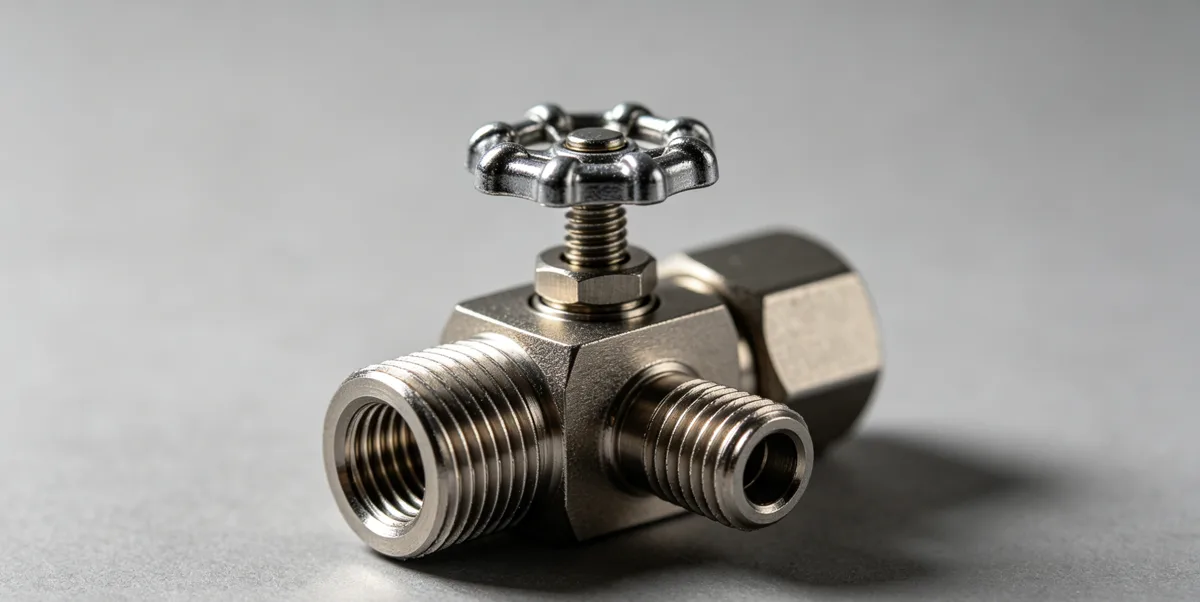
Basic Operating Mechanism
A needle valve controls fluid flow by translating a long, slender, tapered needle-point plunger axially into and out of a precisely machined conical or flat seat port — the same linear motion mechanism as a globe valve, but with a needle-profile closure element that provides a dramatically finer flow area versus stem travel relationship at very small openings. As the stem is rotated, the needle advances toward the seat (closing) or retracts from the seat (opening), changing the annular flow area between the needle taper and the seat bore incrementally with each thread pitch of stem travel. The very shallow taper angle of the needle — typically 15°–30° included angle — means that a relatively large stem travel distance produces only a very small change in flow area, providing the high positional resolution and precise Cv adjustment that define the needle valve’s functional role in instrumentation and small-flow control service.
Needle valves are available with manual handwheel actuation (the dominant configuration for instrument, sampling, and calibration service), vernier-scale handwheels (for repeatable and documented position settings), and in some designs with pneumatic or electric actuators for automated micro-flow control in laboratory and analytical instrument service. The multi-turn stem thread — Acme or fine-pitch UN thread — is inherently self-locking, holding any set position without operator holding force and without back-driving from the differential pressure across the needle. For system-level valve selection strategy, see How to Select an Industrial Valve. For the Cv calculation methodology used to size needle valves for specific flow and pressure conditions, visit Cv Value Explained.
Operating Physics and Flow Behavior
The flow physics of a needle valve at partial opening are governed by the annular flow area between the needle taper surface and the seat bore, and by the viscous and inertial flow resistance in this narrow annular gap:
- Flow area versus stem travel — the needle valve advantage: For a needle with a half-included angle θ (half of the total taper angle) moving axially a distance h from the fully seated position, the annular flow area is approximately A = π × d_seat × h × sin(θ), where d_seat is the seat bore diameter. For a typical needle valve with θ = 10° (20° included angle) and d_seat = 2 mm (a small instrument needle valve), a stem travel of 1 mm produces a flow area of approximately 1.1 mm² — compared to approximately 6.3 mm² for the seat bore full area. This means the needle valve provides approximately 6× more stem travel distance per unit of flow area change than a flat disc globe valve of equivalent seat bore, producing 6× finer flow adjustment resolution per handwheel revolution. For a fine-pitch stem thread of 1.0 mm pitch, each complete handwheel revolution advances the needle 1.0 mm — providing very fine, repeatable Cv changes with each partial handwheel rotation.
- Viscous flow regime at very small openings: At very small needle valve openings — where the annular gap width is on the order of 0.1–0.5 mm — the flow regime in the gap may transition from turbulent to laminar (viscous) flow, depending on the flow velocity and fluid viscosity. In laminar flow, the volumetric flow rate through the annular gap is proportional to the pressure differential (not to the square root of differential pressure as in turbulent flow), producing a more linear flow-versus-differential-pressure relationship than the standard orifice equation predicts. This laminar flow characteristic makes needle valve Cv sizing for very low flow rates more complex — the standard ISA/IEC 60534 turbulent Cv equation overpredicts flow at very small openings in laminar regime service, requiring the use of the laminar Cv correction factor (Fp) from the standard.
- Pressure drop and fully-open Cv: Even in the fully open position, needle valves have a much lower Cv per unit bore size than other valve types — the needle plunger remains in the flow path at all positions, and the seat port diameter is typically much smaller than the connection port size. A typical 1/4-inch stainless steel instrument needle valve may have a fully-open Cv of only 0.03–0.15 Cv depending on needle geometry and seat bore diameter — compared to a full-bore ball valve of the same connection size with Cv of 2–5. This inherently low fully-open Cv is the needle valve’s intended design characteristic for low-flow service, not a limitation — it is exactly the Cv range required for instrument impulse line isolation, chemical injection metering, and analytical instrument sample flow control.
- Pressure-balanced versus unbalanced needle designs: In standard needle valves, the full differential pressure across the seat acts on the needle face in the closing direction when the valve is nearly closed — requiring the stem and handwheel to overcome this hydraulic closing force to open the valve against high differential pressure. At 150 bar differential pressure on a 2 mm seat bore, the closing force on the needle is approximately 47 N — manageable with a standard handwheel. At larger seat bore diameters (above approximately 6 mm) in high-differential-pressure service, the hydraulic closing force increases to the point where a pressure-balanced needle design — with a second port on the needle that applies the upstream pressure to the needle back face, partially balancing the closing force — is required to maintain reasonable operating torque for manual operation.
- Bidirectionality and flow direction marking: Most needle valves are bidirectional — they seal effectively regardless of which end is the high-pressure side. However, some designs (particularly those with soft seat inserts) have a preferred flow direction (flow under needle, into the seat) that provides better sealing and longer seat life. Purchase specifications and installation instructions for soft-seated needle valves must confirm and enforce the correct flow direction orientation.
Related Reading
- Valve Size Calculation — Needle valve sizing requires careful Cv determination at very small flow rates; the Valve Size Calculation guide covers the low-Cv port sizing methodology applicable to instrument and chemical injection needle valves.
- API 602 Compact Forged Steel Valves — The API 602 standard that governs forged steel gate, globe, and check valves in small-bore sizes, providing the design and testing framework applicable to needle valve specifications in process plant instrumentation.
- PTFE vs RPTFE Seat Materials — Needle valve seat material selection for fine-throttling service requires attention to seal material durability under high-velocity flow at small openings; PTFE and RPTFE seat performance characteristics are compared in this guide.
- Chemical Plant Valve Selection — Needle valves are widely used in chemical plant instrument impulse lines, chemical injection systems, and analytical sampling panels; this industry guide provides application-specific material and design recommendations.