
Compare: Gate valve vs globe valve — difference, when to use each & cross-section
For a complete guide to industrial valve types, visit the
Industrial Valve Types Overview page.
1. Working Principle
Basic Operating Mechanism
A globe valve controls fluid flow by translating a disc or plug axially toward or away from a circular seat ring that is oriented perpendicular to — or at a defined angle to — the valve’s stem axis. This linear motion closes the gap between the disc face and the seat ring face, progressively reducing the flow area from fully open (disc retracted clear of the seat) to fully closed (disc seated against the ring with sufficient mechanical load to seal). The stem converts the actuator’s rotational input into axial disc displacement through a threaded connection — typically an Acme or modified square thread — requiring multiple complete rotations to travel from fully closed to fully open, providing the high positional resolution that is the globe valve’s defining functional advantage over quarter-turn designs.
In the standard Z-body configuration, the stem and disc travel vertically, and the seat ring is horizontal, oriented perpendicular to the stem axis. The flow enters the valve body horizontally, is directed downward through the seat port, passes beneath the disc, and is redirected upward and horizontally to the outlet. This Z-shaped flow path is the source of both the globe valve’s elevated pressure drop and its inherently stable throttling characteristic. The disc moves directly into the flow stream, producing a predictable and repeatable Cv-versus-stroke relationship that can be shaped through disc profile design to achieve linear, equal-percentage, or other control characteristics. For system-level valve selection strategy, see How to Select an Industrial Valve. For the Cv calculation methodology that determines bore size and disc profile requirement for a given flow duty, visit Cv Value Explained.
Operating Physics and Flow Behavior
The flow behavior through a globe valve across its full travel range is governed by the annular flow area between the disc lower face and the seat ring bore, which changes continuously and predictably with disc position:
- Flow area versus disc travel: For a flat disc (plug type) moving axially away from a flat seat, the annular flow area is approximately A = π × d_seat × h, where d_seat is the seat ring bore diameter and h is the disc lift (axial travel above the seat). At small lifts, the flow is controlled by this annular area; at lifts above approximately d_seat/4, the annular area exceeds the seat bore cross-sectional area and the seat bore itself becomes the controlling flow restriction. This transition — from lift-controlled to bore-controlled flow — defines the maximum useful control range of the valve, which is typically h_max = d_seat/4 for flat disc designs. Parabolic and needle-nose plug profiles extend the useful control range by modifying the relationship between lift and effective flow area, producing linear or equal-percentage Cv-versus-lift characteristics across a wider travel range.
- Pressure drop at fully open: The Z-shaped flow path through a standard globe valve body — with its two 90° flow direction changes and the internal baffle wall — produces a resistance coefficient K of approximately 3–10 depending on bore size, body geometry, and disc/seat design. This is 10–70 times higher than the fully-open pressure drop of an equivalent full-bore ball valve (K = 0.05–0.15). For a 4-inch globe valve in water service at 3 m/s flow velocity, the fully-open pressure drop is approximately 0.5–1.5 bar — compared to approximately 0.01–0.05 bar for an equivalent full-bore ball valve. This pressure drop penalty is the globe valve’s primary engineering trade-off and must be explicitly evaluated in the system hydraulic model before specifying a globe valve in any service where pump or compressor head is limited.
- Throttling stability and self-locking: The globe valve’s disc travels parallel to the stem axis, and the closing force applied by the stem is axial — in the same direction as the differential pressure force on the disc. When the valve is in a partially open throttling position, the differential pressure acts on the disc in the closing direction (for flow-to-close orientation) or opening direction (for flow-to-open orientation). The multi-turn stem thread is inherently self-locking — the thread geometry prevents back-driving from the differential pressure force on the disc, so the disc remains at any set position without continuous actuator holding force. This self-locking characteristic makes globe valves inherently stable in a manually set throttling position, whereas quarter-turn ball and butterfly valves require active actuator force to hold a partially open position against the closing torque from differential pressure.
- Flow orientation — flow-to-open versus flow-to-close: Globe valves are directional: the preferred installation is flow-under-disc (flow-to-open), where upstream pressure enters below the disc and acts in the opening direction, reducing the required actuator closing force and minimizing seat erosion from turbulent flow. Some high-pressure applications specify flow-over-disc (flow-to-close) to utilize line pressure to assist seating and improve shutoff reliability — but this requires higher actuator opening force and is only used where tight shutoff is the primary requirement and the actuator can be sized accordingly.
- Cavitation in high-pressure-drop liquid service: Globe valves used for high-pressure-drop liquid letdown — where the pressure difference between inlet and outlet is large relative to the fluid vapor pressure — are susceptible to cavitation at the vena contracta (the minimum flow cross-section just downstream of the seat). If the vena contracta pressure drops below the fluid vapor pressure, vapor bubbles form; when they collapse downstream, the implosion generates pressure spikes of hundreds of bar locally, producing rapid pitting erosion of the disc face, seat ring, and downstream body surfaces. Anti-cavitation trim — multiple-stage pressure reduction through stacked disc or cage designs — must be specified for globe valves in high-pressure-drop liquid service to distribute the total pressure drop across multiple restrictions and prevent single-point cavitation.
2. Structural Diagram and Anatomy
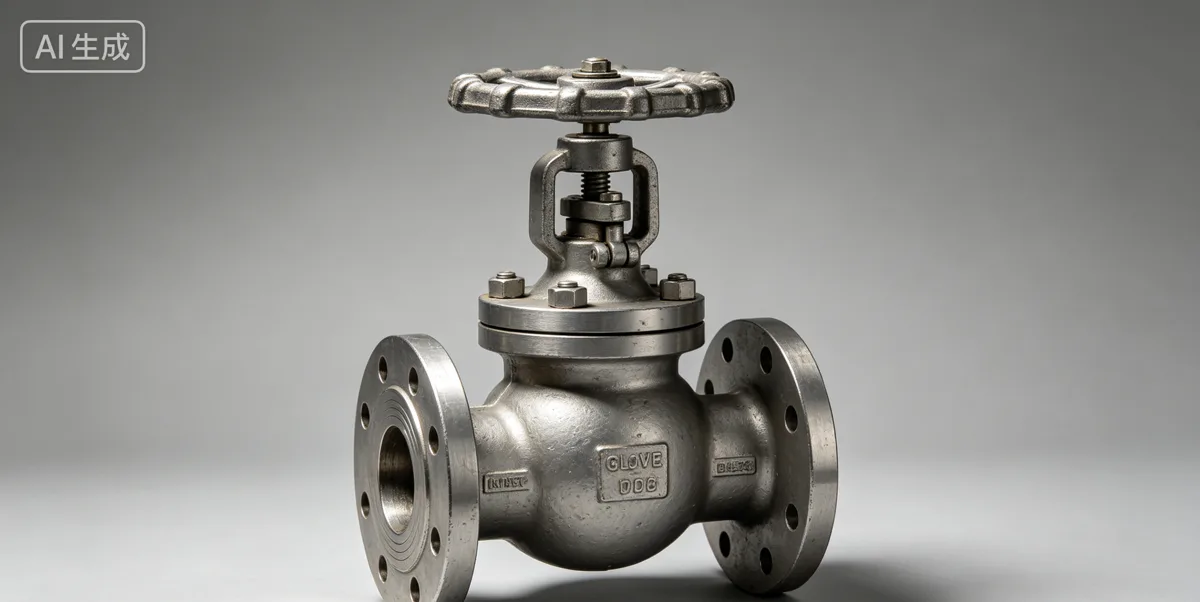
Component Breakdown
A globe valve comprises the following primary structural components, each with defined engineering function and material specification:
- Valve body: The primary pressure-retaining casting or forging providing the inlet port, internal flow passage with baffle wall and seat ring pocket, outlet port, and bonnet flange face. The body geometry — Z-body (standard horizontal-inlet, horizontal-outlet with internal baffle), Y-body (inclined stem at approximately 45° to the flow axis), or angle-body (inlet and outlet at 90°) — determines the flow path characteristics and fully-open pressure drop. Y-body designs provide lower pressure drop than Z-body by reducing the total angular change in flow direction through the valve interior. Angle-body designs are specified for high-pressure-drop letdown service where the 90° flow direction change assists in absorbing pressure energy. Body materials follow the same ASME B16.34 material group and pressure class framework as all other valve types: ASTM A216 WCB for carbon steel general service, ASTM A217 WC6/WC9 for high-temperature service, ASTM A351 CF8M for stainless service, and high-nickel alloy castings for severely corrosive service.
- Bonnet: The upper pressure-boundary casting through which the stem passes, bolted or pressure-sealed to the body. The bonnet houses the packing box, gland follower, and stem guide bushings. In high-temperature service above approximately 300°C, extended bonnets — with a lengthened bonnet section that increases the distance between the packing gland and the process fluid — reduce packing temperature and extend packing service life. Pressure-seal bonnet designs (for Class 900 and above) provide superior high-pressure sealing at elevated temperature through the self-energizing seal ring geometry that ASME B16.34 high-pressure gate valve designs also employ.
- Disc (plug): The closure element that travels axially to change the annular flow area at the seat ring. Disc profile designs include:
- Flat (plug) disc: Flat lower face against a flat seat ring — simple, robust, suitable for on-off and moderate throttling service. Provides a quick-opening characteristic — most of the Cv change occurs in the first portion of travel.
- Parabolic disc: Contoured lower face that produces a linear Cv-versus-lift characteristic across a wider travel range than the flat disc. The preferred disc profile for manual throttling and modulating control applications requiring proportional response.
- Needle disc: Long, tapered needle point that extends into the seat bore — provides very fine flow control at very small Cv values. Used in needle valves (a specialized subset of the globe valve design family) and in small-bore high-precision globe valve trim.
- Composition disc: A resilient insert (PTFE, rubber, or elastomer) in a metallic disc carrier — provides zero-leakage Class VI shutoff for water and clean fluid services at moderate temperatures below the seat insert’s thermal limit.
Related Reading
- Cv Value Explained — Globe valves are the most commonly specified valve type for throttling and control applications; the Cv methodology is essential for sizing globe valves for modulating flow control service.
- API 598 Valve Testing — The factory acceptance testing standard for globe valves, covering seat leakage acceptance criteria for Class IV (metal seat) and Class VI (soft seat) globe valve closure.
- Inconel Properties for Valves — For high-temperature globe valve applications in supercritical steam and heat transfer fluid service, Inconel alloys provide the high-temperature strength required for globe valve disc and seat materials.
- What Does Bubble Tight Mean? — A FAQ explanation of the bubble-tight shutoff leakage class often specified for composition-disc globe valves in clean fluid and water service applications.